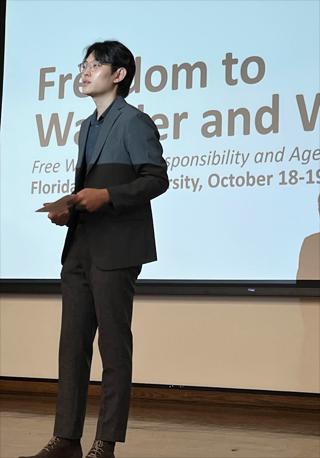
Myungjun Kim

I am a PhD candidate in philosophy at Florida State University. I am currently visiting the Department of History and Philosophy of Science at the University of Pittsburgh. Before FSU, I did my undergraduate and master's studies at Seoul National University.

I work mainly on philosophy of action and philosophy of AI, with related interests in epistemology, language, mind, metaphysics, and ethics. I am also interested in Confucianism, especially how it developed into the Korean Neo-Confucian movement after its transmission from China and how it compares with the Western tradition of thought.

I organized the FSU Annual Free Will, Moral Responsibility, & Agency Conference from 2023 to 2025, serving as lead organizer for the 2024 and 2025 conferences.

In the International Phonetic Alphabet, my name is: mjʌŋ.dʑun. Here is my CV.

Research

Drafts available upon request

Is Deciding a Basic Action?

I challenge the popular view that deciding, understood as forming an intention, is a basic action. I propose a necessary condition for basic action, which I call Intend-ability: a basic action must be something the agent could perform as a direct execution of the specific intention to do it. But even when the agent intends to decide, say, to quit smoking, she cannot directly execute such an intention; she can at most bring it about that she decides to quit, by other actions, such as imagining herself with cancer. Because deciding fails Intend-ability, I conclude that it is not a basic action.


Deciding as a Controlled Achievement

This paper addresses a puzzling dilemma. If deciding to A is an action, it is anomalous because agents do not ordinarily intend to perform it. If deciding to A is not an action, decisions seem to fall outside the control required for responsibility. I propose an account that resolves this dilemma. Deciding to A is a controlled achievement: the nonactional culmination of resolving practical uncertainty. Without specifically intending to decide to A, an agent can form the intention to A as the competent execution of her intention to resolve uncertainty in the way she knows how. This preserves responsibility-level control over decisions without making them an anomalous kind of action. The account extends to judgment and ideation, and to fine-grained, often automatic components of skilled performance.


Creativity, AI, and the Puzzle of Credit

This paper asks what grounds credit for originating a creative idea. A creator can intend to solve an artistic problem but cannot intend, in advance, to form the exact novel idea without already possessing it. Recent accounts (e.g., Prodoehl, Peacocke) locate creative agency mainly in facilitating the production of ideas or refining an idea once it appears. I argue that idea formation itself can be a controlled achievement when it is the culmination of an intention-guided creative search structured by the creator's knowledge-how. On this basis, I explain how outsourcing ideation to AI changes the artist's credit.


Explaining Frege Cases from the Agent’s Point of View

The Explanation Objection, motivated by Frege’s puzzle, holds that Russellian theories of psychological content cannot account for the different explanatory values of mental states that share the same Russellian content. A bold Russellian response, called Exceptionalism, maintains that Frege cases are harmless exceptions to the law-like generalizations grounding intentional explanations, and the Explanation Objection is thus undermined. Focusing on Almotahari and Gray’s (2021) most recent defense of Exceptionalism, I show that it fails to save Russellianism. I bring attention to a crucial challenge overlooked in the Explanation Objection, namely, enabling an action explanation to capture the agent’s perspective so as to rationalize the action. I argue that Exceptionalism fails to meet this challenge. Finally, I assess the failure of Exceptionalism and suggest that Russellians should either reject the thesis that psychological explanation is in terms of intentional contents or adopt a “relationistic” shift from the naïve form of Russellianism.


Work in Progress

A paper on belief and acceptance

Abstract

I argue against a widely discussed contrast between belief as involuntary and acceptance as voluntary. (The debate goes back to Cohen and Bratman.) On my view, neither attitude is acquired at will: coming to accept something is a controlled culmination of assessing what to take for granted, just as forming a belief can terminate an inquiry into whether p. The apparent difference between them is explained by the different questions they settle and the standards they answer to: belief has truth as its constitutive aim, while acceptance is more sensitive to practical context and the cognitive costs of reasoning.


A paper on control in epistemic akrasia

Abstract

I distinguish cases in which belief bypasses inquiry from cases in which it results from poorly executed inquiry. In the first, as Chenwei Nie argues, a vivid seeming influenced by the agent's affective states may produce belief directly. In the second, inquiry remains under her control until its culmination but is distorted by factors such as selective attention or biased evidence collection. I will argue that in bypass cases the agent has at most indirect responsibility, stemming from earlier faults in character development, whereas she can be directly responsible for a belief that is the defective culmination of her inquiry. The upshot is a map of doxastic responsibility tied to a precise account of how control over belief may be compromised.


A paper on the timing of killing

Abstract

I attempt to solve an old puzzle in action theory. Suppose Aaron shoots Bob on Monday, Aaron dies on Wednesday, and Bob dies from the wound on Thursday: when does Aaron kill Bob? I defend the answer that he kills Bob when Bob dies, based on the idea that killing, like winning, is not a process but the culmination of one, an achievement. This does not require Aaron to act while dead: his contribution to the attempt ended before he died, but the attempt culminates when Bob dies.


Teaching

Florida State University: Introduction to Philosophy, Summer 2025


Get In Touch

You can contact me via email.

mkim11[at]fsu.edu